
Judge Bao’s Greatest Hits: Beheading Imperial Brothers-in-Law and Other Bedtime Stories
One of the many government officers during the reign of Emperor Renzong (1010 – 1063) of the Northern Song dynasty was a man named Bao Zheng. Bao Zheng took on many different posts before he was promoted to the position of prefect of the Song capital, Kaifeng and enjoyed a reputation as fair and virtuous judge after his appointments. Although at a glance this seems to be just another long and impressive resume of a successful public servant, Bao Zheng became a special figure as his cases evolved into many legendary acts of justice such as impeaching an uncle of Emperor Renzong’s favourite concubine, punishing powerful corrupted families and even sentencing his own uncle. Not only moving among the circles of the rich and powerful, Bao Zheng was also known to have initiated many legal reforms to better hear the grievances of the people.
By 1250, legends concerning Judge Bao’s insights and fairness have become the stuff of professional oral storytellers and began to find their way into early printed literature. A series of eight ballad-stories on Judge Bao, dating from 1250–1450, not only describe abuse of power and corruption in the courts and bureaucratic services, they also show Judge Bao as the figure who imposed the rule of law to everyone – even on the emperor himself.
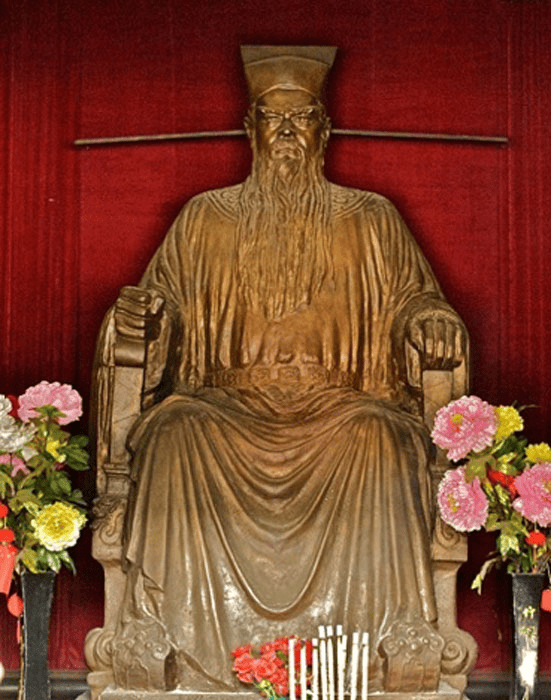
Like many other Chinese legends, myths and Wuxia stories (Wuxia literally means “martial heroes”), the legend of Judge Bao became intermixed with actual accounts of Bao Zheng’s office over time. This resulted in his elevation to divine status. Chinese operas, for example, depict him as an imperial judge with a jet black face and a crescent moon on his forehead. The crescent moon symbolizes brightness and purity. Like the Chinese idiom hào yuè dāng kōng, which means “the bright moon hung high in the sky”, the dark face and crescent moon characterizes Judge Bao’s righteous and upright character as they symbolizes that his pure mind shone brightly in the darkness of the world.
Within two centuries of his death, Judge Bao’s reputation seems to have developed in to that of somewhat of a super-judge. Apart from being an important figure in politics and governance, he had also become an important figure in the religious beliefs of Northern China as the chief judge of the underworld and head of its bureaucracy as his aid was sought for impartial assessment both for the living during the day and for the dead at nights.

Who was the Real Bao Zheng? The Rise of an Honest Public Official in Ancient China
The character of the legendary Judge Bao that we know today was based on that of the Song dynasty official named Bao Zheng (999–1062). Bao Zheng was born into an official family from Luzhou (modern Hefei). His father, Bao Lingyi, was a scholar official and his grandfather, Bao Shitong, was a commoner. Although Bao Zheng’s parents could afford to send him to school when the time comes, they were not always living adequately as his mother still climb mountains to collect firewood close to giving birth to him and Bao Zheng grew up among the working class.
Bao Zheng passed the highest-level imperial examination and became qualified as a Jinshi in 1027. However, he quickly declined an official appointment as a magistrate of Jianchang county to return home in order to care for his elderly parents. He looked after his parents for the next decade and faithfully observed proper mourning rites after their deaths. When he finally set out on his official career, Bao Zheng served in a wide variety of functions in the provinces and in the capital and quickly established a reputation as an honest official and an astute judge.

Most of Bao Zheng’s active service coincided with the uneventful fifteen years of the reign of the fourth Song emperor Renzong. However, this did not stop him from making an impact. In 1040, Bao Zheng was promoted to the position of the prefect of Duanzhou (modern Zhaoqing) in the south. The city of Duanzhou was famous for its high-quality inkstones – a certain number of which were presented annually to the imperial court. Bao Zheng soon discovered that previous prefects had collected far more inkstones from manufacturers than the required tribute and used them to bribe influential ministers. He immediately abolished the practice by telling manufacturers to fill only the required quota.
Bao Zheng was named as an investigating censor in 1044. Within the next few years in his new position, he had already submitted at least a dozen memoranda to the Emperor about the military, taxation, the examination system, as well as governmental incompetence and corruptions.

In less than a year after he was appointed to the position of the prefect of Kaifeng in 1057, Bao Zheng had changed the procedures of justice so that anyone who wanted to lodge a complaint would be able to directly address the prefect himself and bypass the clerks who were commonly believed to be corrupt and being under the sponsorship of powerful local families. In his functions at court, Bao Zheng did not make any close friends as he regularly criticized a wide range of officials which included eunuchs and relatives of Emperor Renzong’s own favorite concubine for a wide variety of offenses and refused to be lenient with them. Perhaps understandably, his tenure as the Kaifeng prefect was relatively short and he was reassigned after one year.
Bao Zheng died in Kaifeng in 1062. He left a warning for his family that, “Any of my descendants who commits bribery as an official shall not be allowed back home nor buried in the family burial site. He who shares not my values is not my descendant.”
Building a Legend: How the Honest Bao Zheng became the Legendary “Judge Bao”
Judge Bao’s stories were retold and preserved particularly in the form of performance arts such as Chinese opera and pingshu (an art of radio entertainment in China). Written forms of his legend appeared in the Yuan Dynasty (1279 -1368) and vernacular fiction of Judge Bao was popular in the Ming (1368 – 1644) and Qing (1636–1912) Dynasties. Stories of Judge Bao revolve around Judge Bao as a public servant and a man of action as he investigates and solves mysteries and criminal cases himself. When Sherlock Holmes was first translated into Chinese in the Qing Dynasty, the Chinese called Sherlock “the English Judge Bao”.

This comparison may not be too strange as, indeed, even from the Yuan Dynasty, many of the rough translations of the titles of the plays which featured Judge Bao as the central character easily reminds us of Sherlock Holmes stories, such as “Judge Bao Thrice Investigates the Butterfly Dream”, “Judge Bao Sells Rice at Chenzhou”, and “Ding-ding Dong-dong: The Ghost of the Pot”.
In the ballad-story “Judge Bao Sells Rice at Chenzhou”, the distribution of government rice to the starving population of Chenzhou was bungled by corrupt imperial relatives. When Judge Bao traveled to Chenzhou disguised as an ordinary student, he discovered a society in which local bullies ruled over their fellow villagers, local magistrates allow their sons to abuse the local population, and imperial relatives line their own pockets with the money they extort from starving townspeople. Of course, the problem they presented was quickly and efficiently dealt with by Judge Bao as the representative of the central government.
The common tendency of these stories was the habit of the villains of refusing to confess to their crimes which provides ample opportunity to progress from caning to the application of the finger press and worse. These descriptions of the villains and forms of torture are written conspicuously. Therefore, the primary issue for Judge Bao the primary was often not how to gain a confession, but how to attract and separate the villain from his armed guards. In order to achieve his ends, Judge Bao would go to extreme length such as pretending to be ill and dying, even faking his own death. He would also use his own wife Lady Li as an accomplice in his elaborate schemes. Once he has caught the villain, his authority would appear to be practically limitless. High officials, and even the empress herself, who come to his office to plead the cases of their protégés would then be brusquely told to go home and quickly leave.

Some time in the first decades of the nineteenth century, a storyteller named Shi Yukun became famous in Beijing for telling tales of Judge Bao’s cases. Using these oral performances as their foundation, local entrepreneurs began to circulate a series of handwritten manuscripts which was then known as wuxia gong ‘an (detective story) also set in the Song dynasty and based on the ascent of the virtuous Judge Bao and his handling of various cases in the interest of peace and righteousness. He enlisted the help of several heroes in the fight against corruption, and their exploits compose the bulk of the story.
In one of the later stories which was written in the Qing dynasty, long after the legend of Judge Bao has been established, Judge Bao beheaded the emperor’s brother-in-law Chen Shimei despite tearful pleas from the empress and the princess. The reason was that Chen Shimei had a wife named Qin Xianglian and two children in their hometown before making his way to the capital city to sit for the imperial examinations. He passed the exam and later married the emperor’s sister, thus becoming the emperor’s brother-in-law, forgetting all about his wife and children in his hometown.
Later, his wife and two children made their way to the capital city to look for Chen Shimei. Not only did Chen Shimei refused to acknowledge them, he also sent someone to kill them. The family escaped death at the mercy of the killer. Qin then sought justice from none other than Judge Bao who prosecuted Chen for his denial of his wife and children, his lie to the emperor regarding his marital status and the attempted murder of his wife and his own children. Judge Bao then decisively beheaded Chen Shimei despite Chen Shimei’s position as the emperor’s brother-in-law.

This story, of course, was heavily embellished. However, the story of the people on which the story was based were no less dramatic. According to court records, there was indeed a government official in the Qing Dynasty named Chen Shumei who had a wife named Qin Xinlian. Chen Shumei was an upright official who did not succumb to the less-than-honest of other officials. Over time, to slander and smear Chen Shumei and his wife Qin Xinlian, these corrupt officials commissioned stories of two fictitious husband-and-wife characters called Chen Shimei and Qin Xianglian, narrowly avoiding charges of slander by changing the middle characters of their real names. The best part of this smear campaign was that the already legendary figure of Judge Bao was written into the story to accentuate the degree of evil in Chen Shimei’s crime and the consequence he should endure. This then served as an oblique reference to the real Chen Shumei.
Why was Bao Zheng so Special? The Legend of the Ruthless Judge
As there must have been thousands of judges in ancient China, one might wonder what it was that made Bao Zheng so special that he was the one chosen to be the preeminent embodiment of justice in China. The reason may be that Bao Zheng, the man, is far more than an upright and astute judge, of which presumably Ancient China had many. Pure, orthodox and incorruptible in his own behavior, as soon as he established the true nature of the crime and its culprit Bao Zheng was known to be relentless in seeing to it that the criminal was punished, regardless of their connections and position. This is a courageous quality especially in an ancient society where classes and positions in society were strictly observed. It is perhaps this quality that has endeared Judge Bao to Chinese audiences for centuries.
In the decades following his death, the legend of Judge Bao developed so much that he was compared to King Yama, the highest judge in the underworld. Later, the Jürched officials administering North China following their conquest of that region in 1126 were ironically referred to by the local population as wanfu Bao daizhi (“Best o’luck Rescriptor Baos”). By the thirteenth century, people in North China believed that Judge Bao had been appointed the presiding judge in the Court of Swift Retribution, one of the seventy-two courts in the infernal bureaucracy of judgments of the dead.

The fugitives who fled North China following the Jürched conquest would have taken the legend of Judge Bao to the South, and it is possible that the professional storytellers of Hangzhou included aspirational tales featuring Judge Bao when narrating tales of court cases thereby including stories of Judge Bao in court documents.
The ballad-stories on Judge Bao provide us with the most complete reflection of the legend of Judge Bao in the earliest phase of its development in written literature. In the ballad-stories, the main antagonists of Judge Bao are members of the imperial family who abuse their privileged positions to give free rein to their lust and greed. As a result, Judge Bao cannot be just the deus ex machina who appears at the very end of the story to dispense justice and restore order, but he has to be a major character in each of the ballad-stories. Dealing with outrageous crimes, he became both an exemplar of moral rectitude and a low-born trickster, who at times even seems to enjoy the opportunity to inflict pain on the high and mighty who have strayed from the virtuous way of life. As the elder brother of Empress Cao (1016 – 1079), the consort of Emperor Renzong was noted to have warned his mother of Bao Zheng, “He loves to sentence the emperor’s kin and relatives.”